Skip to content
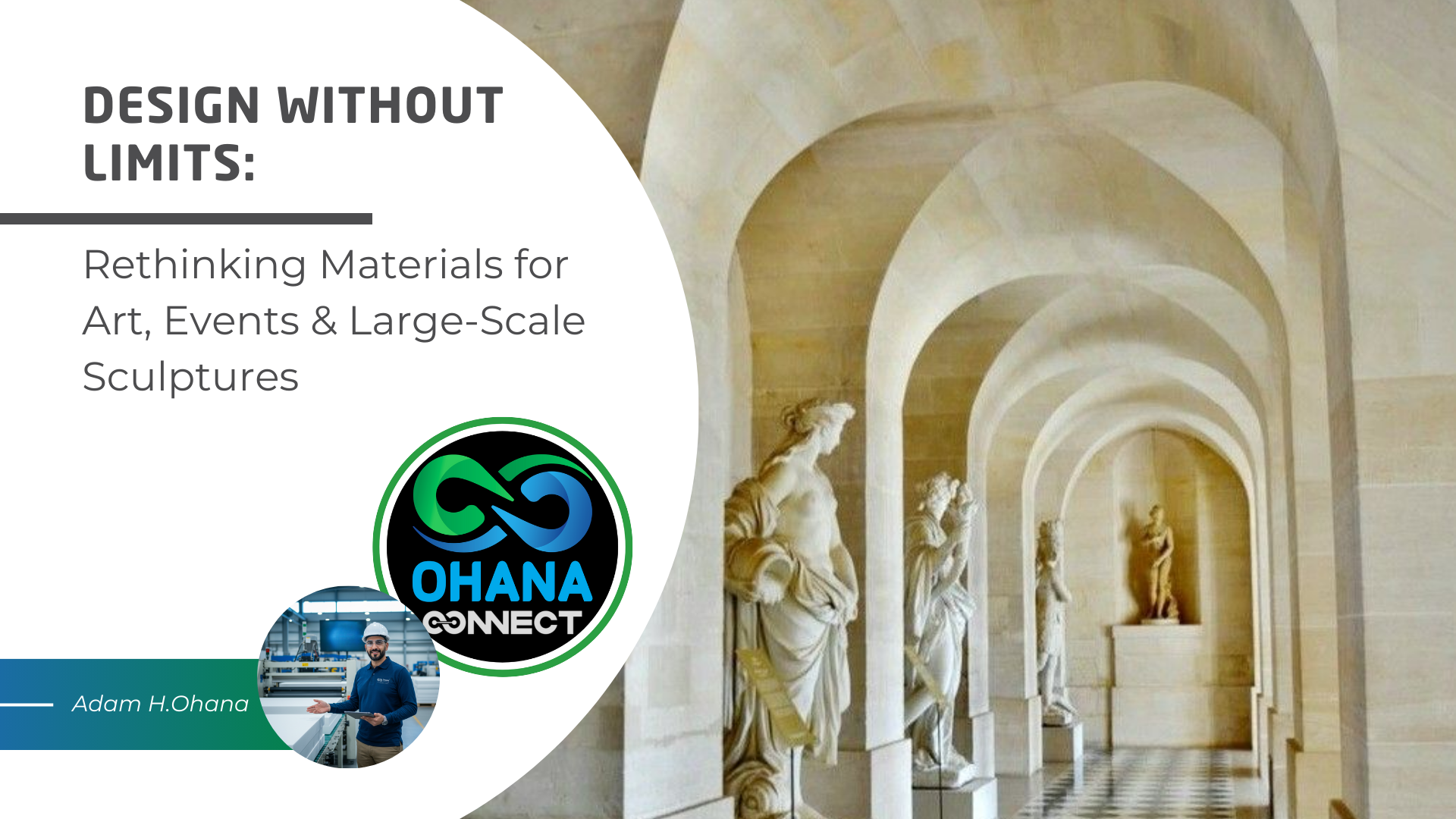
Large-scale art and event installations are no longer just about visual impact. They demand speed, precision, complex geometry, and safe handling — all under tight timelines.
Traditional materials struggle to keep pace.
When Creativity Outgrows Traditional Materials
Modern installations require: Speed, Precision, Complex geometry, Safe handling.
Yet traditional materials struggle to keep up:
Wood → Heavy, warps, joint-limited, Gypsum → Fragile, moisture-sensitive, GRP → Mold-dependent, labor-intensive, Concrete → Excessive weight, logistics, long timelines
Creative work today needs materials that follow imagination — not restrict it.
That’s where EPS enters the conversation.
Geometry Freedom: From Blocks to Complex Forms
Design complexity is no longer the challenge. Material adaptability is.
EPS (OHANAFOAM) enables: CNC hot-wire cutting, 3D contour profiling, Seamless curves, voids, and undercuts, High repeatability across multiple elements
Technical advantages: Density-controlled EPS cuts without internal stress, No grain direction (unlike wood), No crack propagation (unlike gypsum)
For sculptors and stand designers:
OHANAFOAM EPS converts digital design → physical form with minimal translation loss. Form complexity becomes scalable, not risky.

Structural Performance Without Structural Burden
Large installations rarely fail due to design. They fail due to self-weight.
Material comparison: Concrete → High strength, extreme dead load, GRP → Strong shell, heavy sub-structure required, Wood → Limited spans, joint dependency
EPS (OHANAFOAM) engineering strengths: Ultra-low density (typically 12–60 kg/m³), High strength-to-weight ratio, Easy integration with steel or aluminum frames
Result: Safer installations, Reduced foundation and support demand, Faster on-site assembly
Lightweight design isn’t aesthetic — it’s structural intelligence.
Surface Engineering: From Foam to Finished Form
EPS is a substrate, not a finish.
Its engineering value lies in compatibility with advanced surface systems: Cementitious coatings, Acrylic and elastomeric renders, GRP skins, Hard-coat systems
Why EPS performs reliably: Dimensional stability, Strong adhesion when primed correctly, No shrinkage cracking
Technical reality:
Durability depends on the coating system design — not the foam alone.
When engineered correctly, EPS installations withstand: Handling and transport, Weather exposure, Long display and event cycles.

Lifecycle, Logistics & Cost Engineering
Creative projects operate under intense time and cost pressure.
EPS delivers advantages across the full lifecycle: Faster fabrication → shorter lead times, Lightweight shipping → reduced logistics costs, Modular construction → easy assembly and dismantling, Reusable cores → more sustainable practices
Hidden cost reductions include: Lower labor fatigue, Less transport damage, Reduced installation risk, Fewer schedule overruns
Engineering takeaway: EPS (OHANAFOAM) doesn’t replace craftsmanship — it amplifies it.